
El Paso City Directory Collections
El Paso has a layered directory shelf rather than one continuous publication. UTEP makes early volumes freely available online. Border Heritage at El Paso Public Library keeps directories alongside newspapers, maps, yearbooks, vital indexes, cemetery material, and vertical files. The El Paso County Historical Society extends the local directory run through 2011 and holds related photographs, annuals, maps, journals, and family or business material. Each collection answers a different part of a household question, and a year gap should be treated as a gap, not as proof that a person left town.
| Collection | Known years | Where held | Access route |
|---|---|---|---|
| Early El Paso directory scans | 1885-1906, with listed runs | UTEP ScholarWorks | Free itemized online images |
| City directories | 1886-2011 | El Paso County Historical Society | Research Library and collection access |
| Genealogy and local-history references | Years vary by item | Border Heritage, El Paso Public Library | Reference research, in person or remote help |
| Marriage, church, and archive companions | Collection dependent | FamilySearch and UTEP Special Collections | Login or collection-specific access may apply |
Record the exact volume, page, publisher, and year before comparing a listing with another source. The early scanned material is image-based, so full-text searching and every possible entry field are not guaranteed. Later Historical Society material is also a collection to consult, not a promise that every annual volume or address is available in the same way.
El Paso Printed Volumes Online
UTEP’s digitized collection identifies a remarkably early run: Rackliff & Wainey for 1885; C. A. Gould for 1886-87; El Paso Directory Co. for 1888 and 1889; the El Paso & Juarez classified business directory for 1892-93; Frank J. McDevitt for 1895-96; Evans & Worley for 1896-97; and Worley or Buck’s-related volumes from 1898-99 through 1906. The publisher label is part of the citation, because the organization and arrangement can change from one run to the next.
The UTEP digitized city-directory collection displays item-level records for the early volumes.
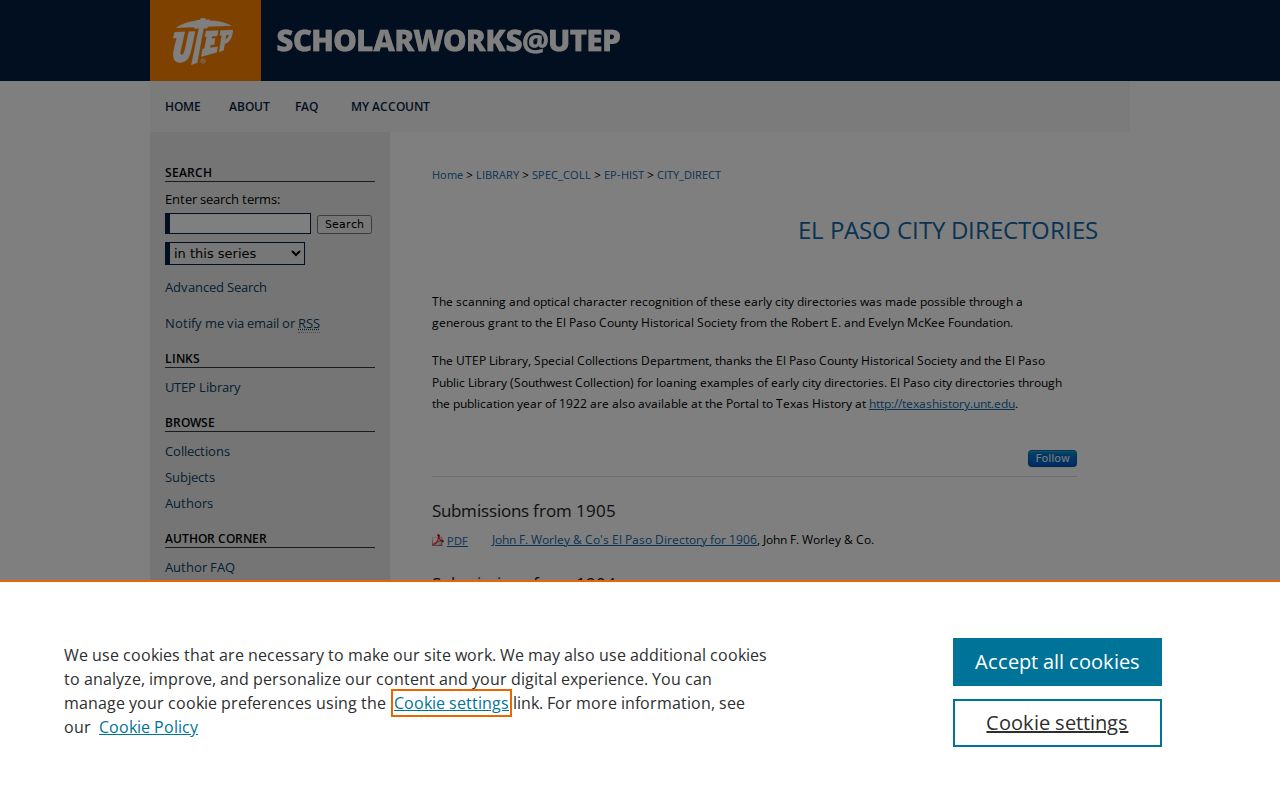
Use the item title and scan itself to preserve the volume’s wording. One abstract describes a general alphabetical citizen and business directory, a classified business directory, a complete street guide, and miscellaneous local information, but that does not mean every volume has the same divisions.
El Paso Border Heritage Directory Help
Border Heritage combines the Southwest, Genealogy, and Raza collections, a department formed in 1995 from those three collections. The library says regional-history collecting began in 1902. Its Southwest holdings include El Paso Times and El Paso Herald-Post microfilm or fiche, maps, periodicals, vertical files, and high-school yearbooks. The genealogy material adds printed directories, census and cemetery references, vital indexes, and research guides. That mix is useful when a directory entry supplies only an initial or an unfamiliar street spelling.
Start with the Border Heritage research service for the library’s current collection information and assistance routes.

Staff assistance is available in person and remotely at 915-212-3218 and libborder@elpasotexas.gov. The listed schedule is Sunday 1-6, Monday 10-6, Tuesday through Thursday 10-7, Friday 1-6, and Saturday 10-6; check the live library page before planning a visit.
El Paso Historical Society Directory Shelf
The El Paso County Historical Society supplies the longer local shelf. Its collections page describes city directories from 1886 to 2011, more than 20,000 digitally archived photographs from the 1880s to the present, maps from 1859 into later twentieth-century decades, more than 500 school annuals, Password journal issues from 1956 forward, and family or business records. This is where a surname, building, school, or organization mentioned in a volume can be checked against other local artifacts.
The Historical Society collections page introduces the directory, map, annual, and photograph holdings.
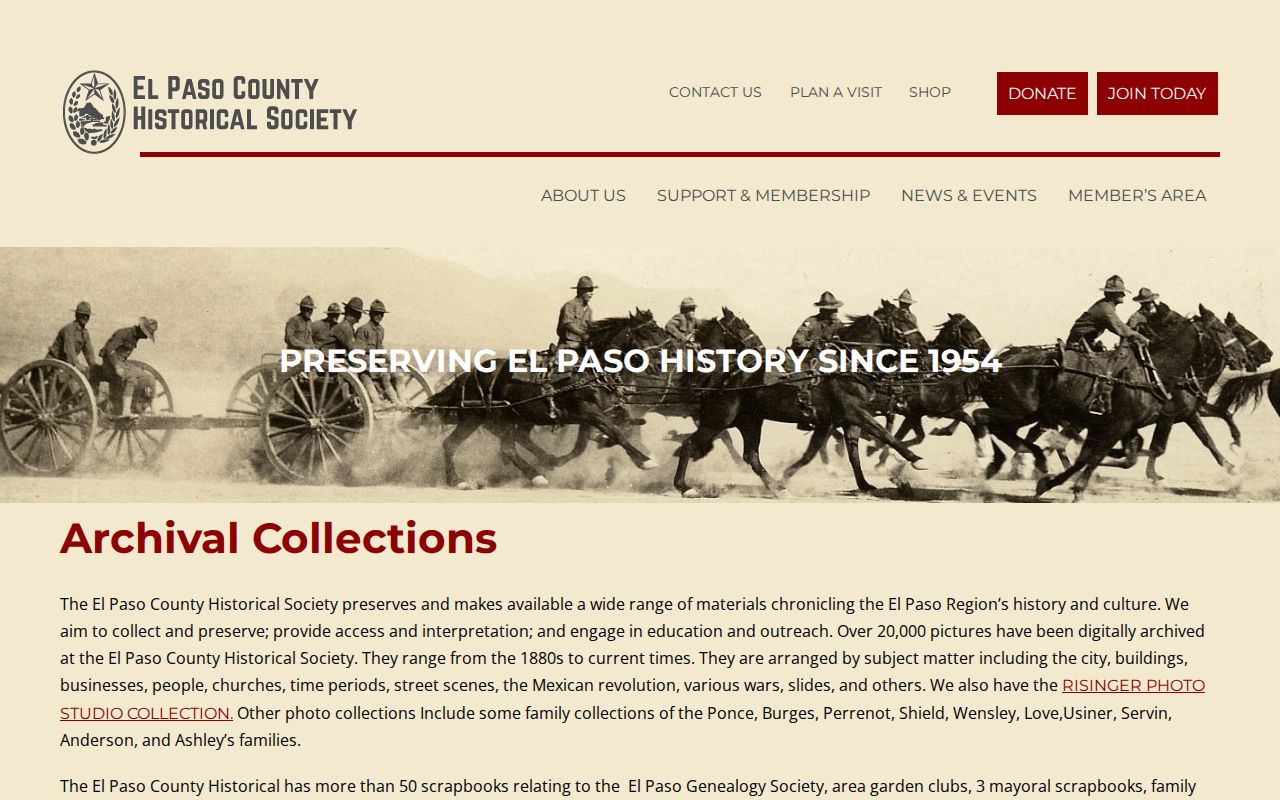
The Jane Burges Perrenot Research Library is at 603 W Yandell and is described as free, open three days weekly, and available by appointment. A different older page gives other hours, so confirm the current schedule with the Society before treating it as a visit plan. Member-area materials require login.
Reading an El Paso Directory Entry
A printed entry is an index to a moment, not a modern identity record. Texas State Library guidance says directory fields can include a name, address, phone, spouse, occupation, and owner or renter status, but the fields vary by publisher and year. Write down only what the volume actually prints. If a spouse, occupation, or ownership mark is absent, do not fill it from another year. The opening pages and abbreviation key often explain the publisher’s own shorthand better than a later reader can.
| Name line | Usually the printed name or business name. Initials, spelling, and order may vary by volume. |
|---|---|
| Address or street guide | A residence, business, or street-guide reference when the particular volume includes one. |
| Household detail | A spouse, relationship marker, or householder treatment may appear, depending on the publisher. |
| Occupation or business | Context for a date, not proof of a current role or present location. |
| Marks and abbreviations | Read against that volume’s key; owner or renter notation is not uniform across all runs. |
- Criss-cross directory
- A directory section arranged by street and address rather than alphabetically by name, when the volume includes one.
- Householder index
- A name-oriented section that can point a researcher to the household line or address as the publisher arranged it.
- Abbreviation key
- The publisher’s guide to shortened terms and symbols, usually near the front matter and worth capturing with the entry.
El Paso Directories with Maps and Yearbooks
When a city-directory line is hard to interpret, use a companion source that answers a different question. Border Heritage holds newspaper microfilm, maps, yearbooks, and vertical files. The Historical Society adds annuals, photographs, maps, and journals. UTEP Special Collections has about 700 archival collections and 185 catalog records or finding aids, including W.H. Timmons, Robert Ewing Thomason, Cleofas Calleros, and Southern Pacific material. A finding aid describes a collection; it does not automatically provide a digitized item.
For a building or street context, the Library of Congress has a 1952 El Paso Sanborn map collection with 60 sheets. Preserve the volume, sheet, original street spelling, and date when comparing it with a directory. A map can describe a built environment, while a directory can show a printed listing. Neither alone certifies ownership or proves present residence.
Tracing an El Paso Directory Household
A household trail works best as a dated sequence. Begin with the first volume where the surname, business, or address appears. Copy the listing as printed, including initials and abbreviations. Move one available directory year at a time, noting an address change, an altered business description, or a missing line. Then use the next census period, an obituary or newspaper notice, a church or marriage index, or a map to test the change. The goal is a documented timeline, not a claim based on a name match.
- Save the collection name, volume year, publisher, page, and exact printed name.
- Check the next available directory year for the same spelling and plausible variants.
- Compare an address move with the volume’s street guide or a historical map.
- Pair the interval with an appropriate census, newspaper, obituary, church, or marriage source.
- Use a county instrument or certified-copy route only when the question requires that separate record.
A disappearance can mean a move, death, omission, changed spelling, nonresident status, or a publication-timing issue. If the relevant source has been checked without success, record that no listing was located in the inspected volume instead of converting absence into a conclusion.
El Paso Directory Names in Their Period
Place names deserve the same care as surnames. El Paso County was established in 1850, with San Elizario as its first county seat; El Paso became the county seat in 1883. Historical research also notes overlap in the use of Franklin and El Paso into the 1880s. A directory, deed, marriage record, or catalog entry may therefore use a period label that a modern search does not expect. Search the printed place name first, then document the chronology rather than silently replacing it with a current label.
This local-history detail helps explain why a scanned volume, map, or archive catalog can appear separate from a modern county search. It also keeps a historical directory record in its proper time and geography, especially when it is being used for genealogy or an institutional history.
El Paso City and County Records
City directories are historical publications, while government offices keep different record types. A City of El Paso permit can provide structure or project context, and Municipal Court handles Class C misdemeanors and city parking citations. County courts, the County Clerk, and the District Clerk cover other jurisdictions and records. Check the situs and record custodian before moving from a directory line to an official source. For a current address-keyed records workflow, use the site’s El Paso street address directory rather than treating an old printed address as current.
The city’s GIS, street-centerline, parcel, and planning systems also have narrower roles. They can help test a street spelling, address range, parcel geometry, or planning area. They are not a substitute for a deed, a current residence finding, or a directory volume. Keeping those roles separate makes the historical shelf more useful and reduces mistaken matches.