
Finding El Paso Residents by Record
El Paso County does not keep one all-purpose list of residents. It keeps different public records for different events. The El Paso Central Appraisal District connects an account and tax year to a property record. The County Clerk indexes recorded instruments. Texas provides a voter-status route with guarded fields. Border Heritage and local archives preserve older directories, newspapers, maps, and yearbooks. A party name in a deed, a directory line, and a current appraisal account are separate facts. The useful result is a dated trail, not a claim built from one matching name.
Choose the first source from what is already known. An exact address supports a property and street check. A full name with an era may fit a directory or eligible county index. A legal matter belongs with the correct court. Historic research benefits from preserving the original spelling, volume, page, and date. If an online screen is incomplete, use the office, library, archive, phone, mail, or written request channel named by the custodian.
- Normalize an address through the USPS tool and City street centerline before matching it to a parcel.
- Use EPCAD to narrow a tax-year account, owner-name field, address, Property ID, or GeoID.
- Follow an ownership lead to current Official Public Records or the historic deed index, based on period.
- For an older household, compare a UTEP directory or Border Heritage item with newspapers, maps, or an official index.
- When an image is not online, ask the actual custodian for a copy or send a focused Public Information Act request.
Note: Record whether a source is an index, image, appraisal entry, or archive listing because those labels set the limit of what it can establish.
El Paso Residents Record Offices
Three offices supply much of the public trail. The County Clerk handles recording and vital-record functions, EPCAD supplies appraisal records, and the Texas Secretary of State runs the official voter portal. Court and municipal records follow jurisdiction instead of one countywide screen. Each office answers a narrow question, so an address search should not be used as proof of every person associated with a property.
El Paso County Clerk Recording Division
500 E San Antonio Ave, Suite 105
El Paso, TX 79901
915-273-3200
Texas Secretary of State
Statewide voter information
El Paso County selection available
Official online route
For a street-level sequence of appraisal, mapping, and deed sources, the El Paso by-street directory keeps the address steps together.
El Paso Property Search Fields
The EPCAD search box accepts a name, address, Property ID, or GeoID. Its advanced form separates owner name, address, Property ID, Geographic ID, subdivision, condo, and Doing Business As. Result controls include tax year, type, results per page, sorting, and sort order. The district says an owner search accepts LastName FirstName or LastName, while an address search accepts a street number and name or the street name alone. That syntax can reduce false starts in a large county.
| Field | Format or role |
|---|---|
| Owner name | Last name, with optional first name |
| Address | Street number and street name, or street name |
| Property ID / GeoID | Property-specific identifiers accepted by EPCAD |
| Subdivision / condo | Advanced selectors for narrowing a property question |
| Tax year and sorting | Result controls that should be noted with the retrieval date |
The EPCAD property search showed 2027 work in progress when researched and describes prior-year information as informational. It also notes that building and land detail may be unavailable before 2013. Treat a returned row as a tax-year appraisal lead, then corroborate an ownership question with a recorded instrument.
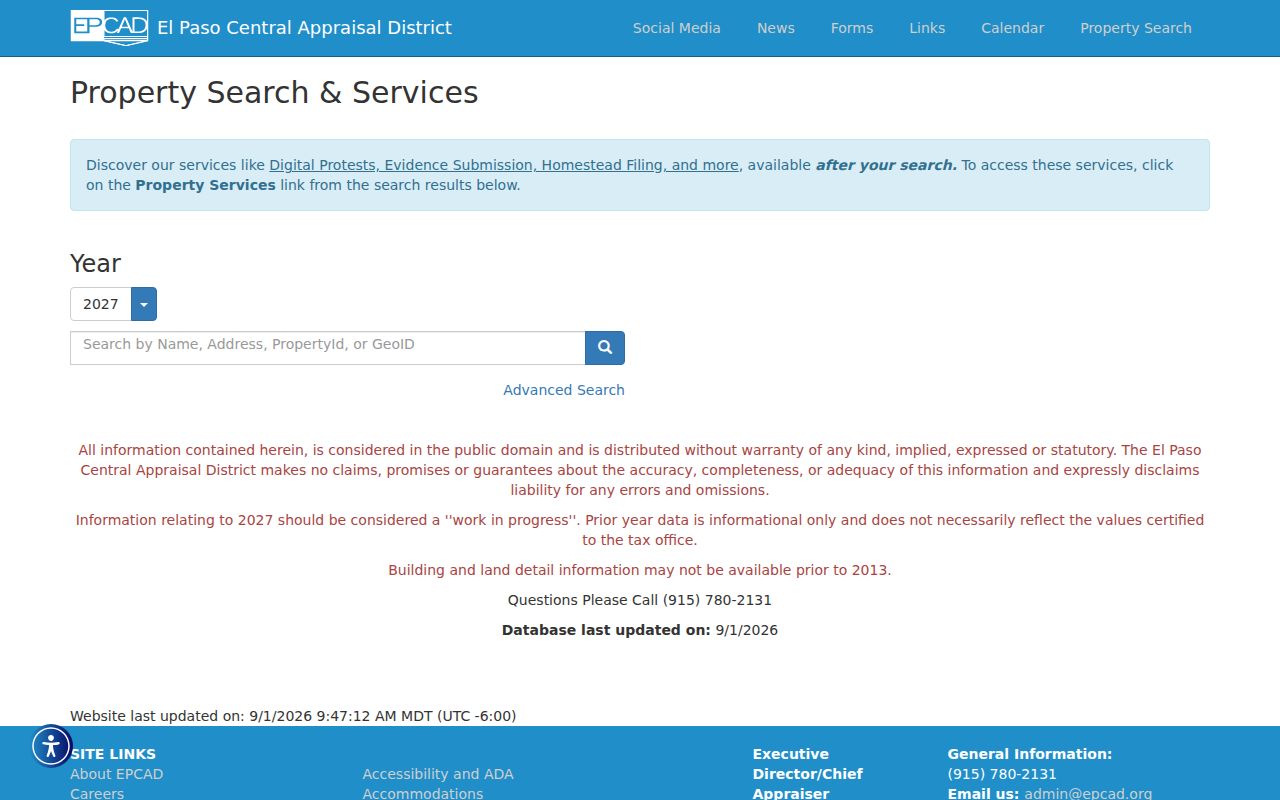
The screenshot shows the public property-search entry point, not a result about a private person.
El Paso Deed Index Windows
Recorded documents offer a time-stamped party and instrument trail. The County Clerk separates the Historic Deed Index QuickLink from current Official Public Records. The historic system covers 1874 through 1963 and searches index books by type, year, party role, surname, and given name. It also supports book, volume, and page searching. A hit can lead to a date, party role, book, volume, page, and document link, while image purchase may require an account.
The current portal supports document number, deed name, subdivision, document style, book, page, lot, block, unit, tract, and file-date range. It caps a search at ten documents and directs users to submit again for more. Its own warning says it is not a professional title or lien search. Keep grantor and grantee roles exactly as indexed, and request the image from the Recording Division when the legal meaning matters.
El Paso County Official Public Records provides the current form and its document-type selector.
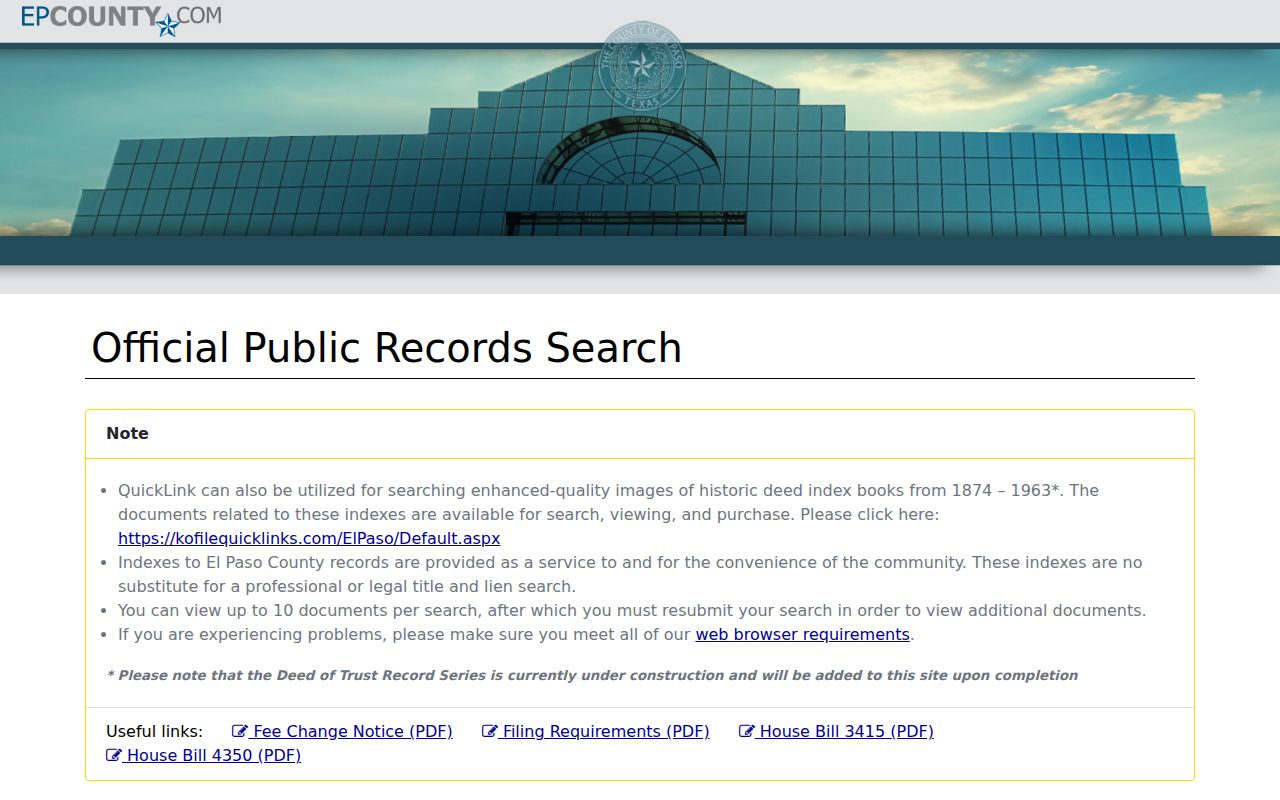
The form makes the current-record search limits visible before a researcher begins narrowing a result.
El Paso Court Record Lanes
Case records must be matched to the court with jurisdiction. County courts at law handle Class A and B misdemeanors, civil matters, and probate. District courts handle district-level civil, family, felony, and other assigned matters through the District Clerk. The City Municipal Court handles Class C misdemeanors and civil parking citations in city limits. A case appearance is a lead about a case, not proof of identity or residence.
Odyssey public civil, family, and probate search allows Case, Party, Business, Attorney, or Bar Number, then case type, case status, and date range. Its criminal search has case, defendant, business, citation, attorney, and bar-number routes, plus name components, Soundex, status, and dates. Texas re:SearchTX is a separate statewide discovery route and had a dynamic-access limitation during research. For copies, use the District Clerk public-access and request channels instead of assuming the portal contains the complete file.
Current El Paso Residents Directory Sources
These sources are directory-like only within their stated purpose. The appraisal search names an account field and property context for a tax year. A voter lookup confirms registration information under Texas rules. The recorder names parties to instruments. Courts name parties to cases. None should be flattened into a current household list, and confidential fields or protected addresses do not belong in a personal research file.
| Record source | What it can confirm | Custodian | Access route |
|---|---|---|---|
| Appraisal search | Tax-year account, visible name and address fields | EPCAD | Public portal and data downloads |
| Voter lookup | Registration or VUID information under SOS rules | Texas Secretary of State | My Voter Portal and election office process |
| Official records index | Parties and recorded document references | County Clerk | Current portal, historic index, copies |
| Court index | Case party, type, status, and docket lead | Correct court clerk | Odyssey, re:SearchTX, office requests |
| Historic directories | Printed household or business context for a period | Libraries and archives | UTEP, Border Heritage, Historical Society |
A name-first question often needs the more careful steps on the El Paso resident lookup page, especially when court, vital, or confidentiality limits are involved.
El Paso Voter Record Boundaries
Texas My Voter Portal is an official status lookup, not a broad residential-history system. The state guide describes name, county, date of birth, and ZIP as lookup inputs and registration or VUID information as a result. The live form was dynamic during research, so its current required controls and columns should be checked on the portal. Use the county and allowed disambiguators only for a lawful, specific question.
Texas confidentiality rules matter here. The SOS describes public and confidential voter fields, web-suppression requests, a Confidentiality Affidavit route, and protections tied to the Attorney General Address Confidentiality Program. A registration result can change and is not proof that someone currently lives at a particular published address. The official path for a question or suppression request is the Texas voter confidentiality guidance.
El Paso Public Information Requests
When a record is not in a public index, identify the custodian before writing. Texas Public Information Act requests are written requests under Government Code Chapter 552, and the county says it responds within ten business days subject to volume and exceptions. The County Clerk is not the custodian for environmental or tax records, so a request for those materials belongs with the responsible agency. A focused record category, date range, and preferred delivery format are more useful than a request for every record about a named person.
The county lists payment methods and notes that cards may carry a charge. Texas Attorney General guidance says estimates are required above $40, and qualifying requests above $100 may require bond or prepayment. Those rules describe the request route, not a promise that a record will be released.
El Paso County Public Information Act instructions are the starting point for current forms and procedures.
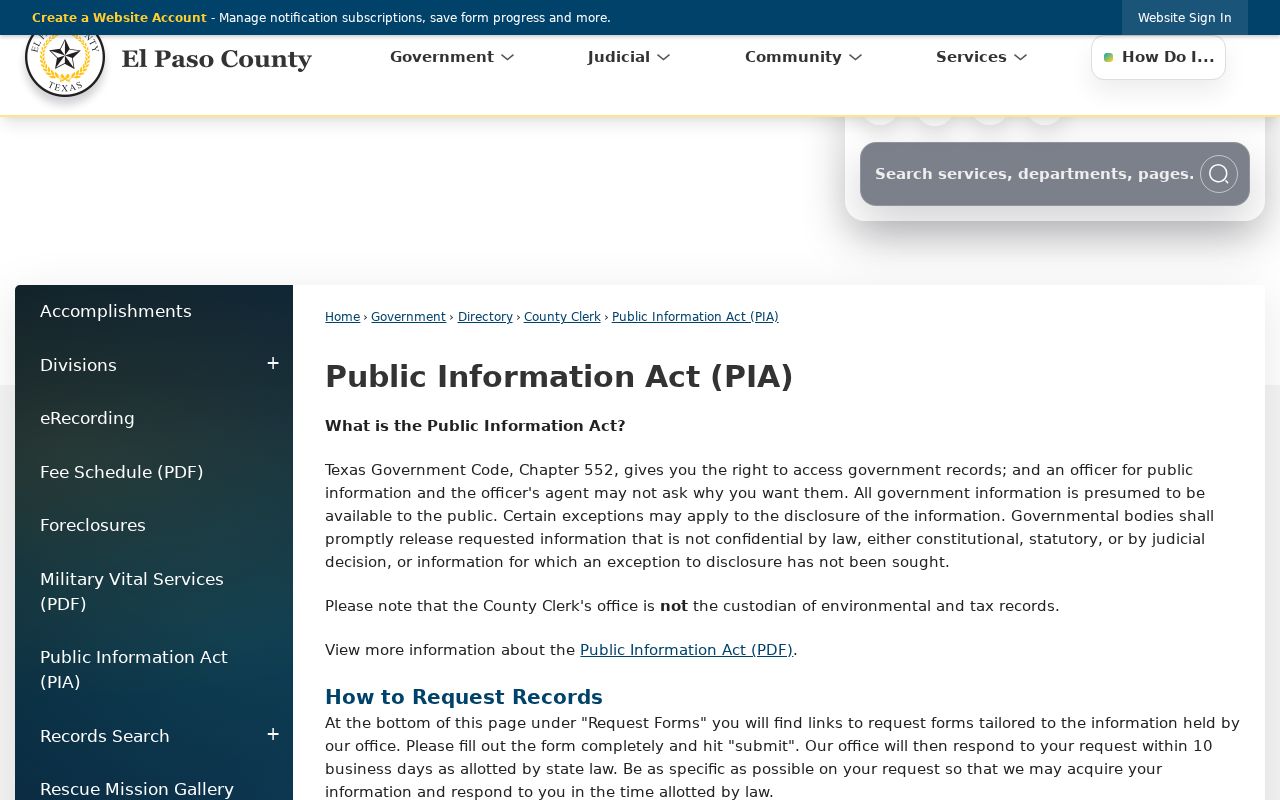
The county page directs a requester toward a procedure rather than treating every office record as an online search result.
Historical El Paso Residents Directories
Historic listings have their own shelves and dates. UTEP provides free digitized El Paso city directories from 1885 through 1906, including Rackliff & Wainey, C.A. Gould, El Paso Directory Co., McDevitt, Evans & Worley, and Worley or Buck's runs. The item descriptions identify alphabetical citizen and business material, classified listings, and street-guide content. Because the scans are images, exact OCR and page-level searching are not guaranteed.
Border Heritage has city directories beside newspapers, maps, yearbooks, vital indexes, and cemetery material. The El Paso County Historical Society extends directory coverage from 1886 through 2011 and holds maps, photographs, annuals, journals, and family or business records. The city-directory collections page explains how to read those volumes without converting a printed line into a current-residence claim.
El Paso Addresses Need Layers
An address can be correct for one system and incomplete for another. USPS answers delivery and recognized-city questions. The City street centerline contains roadway name, direction, type, left and right address ranges, ZIPR, ZIPL, MUNR, MUNL, aliases, planning area, and edit date. City parcel GIS supplies geographic context. EPCAD adds a tax-year account. The County Clerk index adds a recorded-instrument lead. These systems may use different update schedules and purposes.
- Parcel
- A mapped unit of land used for assessment or geographic work; its shape is not itself a recorded deed.
- Situs address
- The property location used by a record system, which EPCAD says it does not independently verify.
- Index
- A search aid pointing to a record or instrument, rather than the certified record itself.
- Criss-cross directory
- A historical address-oriented directory that may group listings by street instead of by surname.
Note: Keep the source date with each address value because postal, mapping, appraisal, and historical-directory labels can change independently.
El Paso County Digitization Context
The split between older and current record tools has a local access history. The County Clerk 2024 annual report describes a $480,000 Electronic Recording Technology Board grant and scanning partnerships for records from the 1980s. It reports 104,135 documents, 490,273 pages, and 86,049 e-recordings in 2024. That work can change remote image availability, but it does not remove an index limit, a legal access rule, or the need for a custodian copy.
The county Records Search hub gathers clerk, court, jail, deed, tax, and state routes in one official directory.
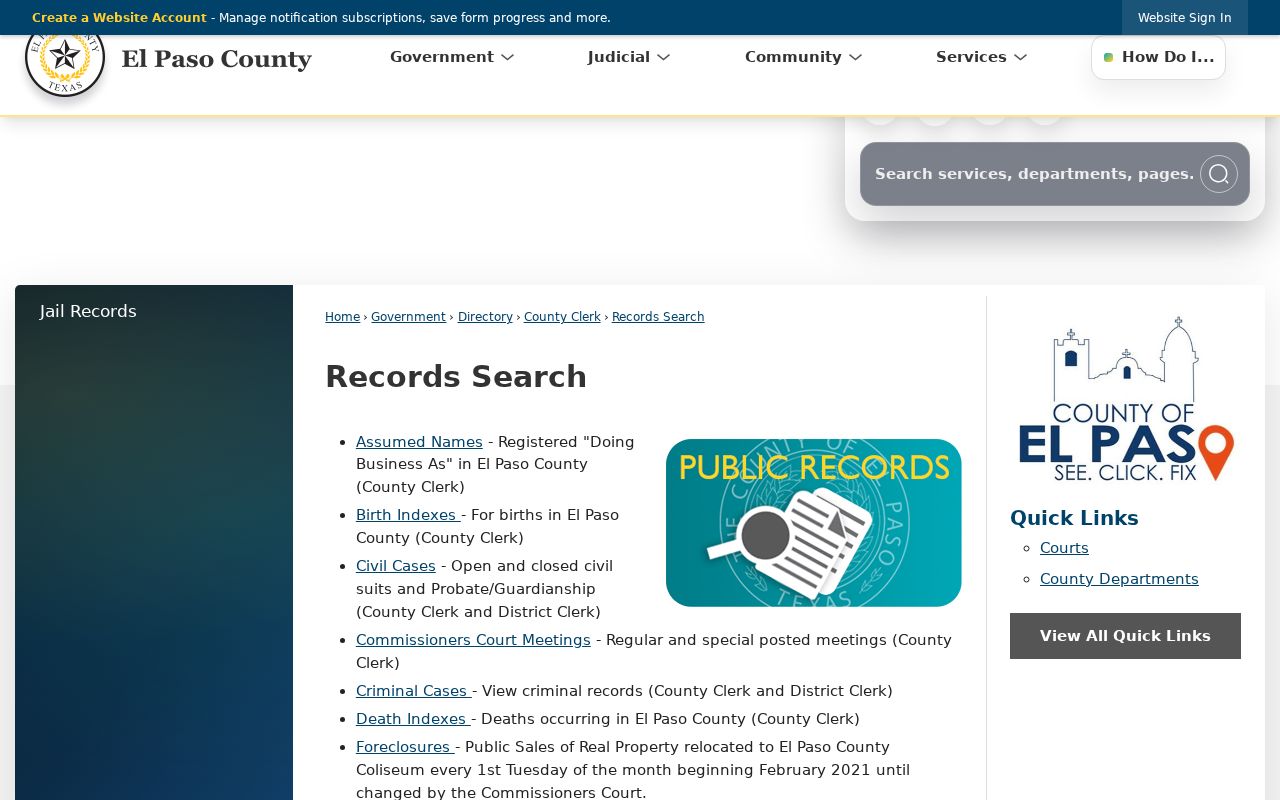
The official hub is useful for selecting a custodian before opening a specialized search form.
El Paso Vital Record Access Gates
Vital records use a different access path from an appraisal or deed index. Texas restricts birth records for 75 years after filing and death records for 25 years. The El Paso County Clerk offers local walk-in and satellite service for birth, death, and marriage records, while Texas DSHS supplies statewide ordering, verification, applications, and data-request routes. Eligibility, identification, relationship, tangible interest, record type, and the record's age can all control the available product.
For historical research, the County Clerk birth index says births become public 75 years after filing, and its death index says deaths older than 25 years are public for events occurring in El Paso County. DSHS describes public summary indexes as a more limited category. A local mail application requires event and requester information, identification, and specified payment. When a record is restricted or a search result is not displayed, use the Vitals Division, the DSHS process, phone or email help, mail, or the documented data-request channel instead of inferring the missing details.
El Paso Library Research Ladders
El Paso's archival path is broader than a single digitized directory. Border Heritage combines Southwest, Genealogy, and Raza collections and traces regional-history collecting to 1902. Its holdings include El Paso Times and Herald-Post microfilm or fiche, maps, yearbooks, vertical files, cemetery records, city directories, and research guides. Staff assist remotely and in person. Library-card access can also open NewsBank Heritage Hub for obituaries and death notices, news, Hispanic Life, and military material.
UTEP Special Collections describes approximately 700 archival collections and 185 catalog records or finding aids. The Historical Society adds its research library, maps, photographs, annuals, Password journals, directories, and family or business material. A source behind a library card, membership login, or appointment should be labelled with that condition. An unlocated directory entry or archive item is still useful negative evidence when written as an inspected-source gap, not as proof that a person or household was absent from El Paso.