
El Paso Previous Residents Sources
An El Paso address history works best as an evidence trail. Different sources answer different questions: a deed index can point to an instrument, a directory can print an occupant or business, a Sanborn sheet can show built context, and an appraisal account can provide a tax-year lead. Start with the source nearest the era being studied, record its coverage, and avoid merging the results into a single unsupported statement.
| Source | Years | Where | Shows |
|---|---|---|---|
| Historic Deed Index QuickLink | 1874-1963 | County online index and Recording Division | Party role, date/year, book, volume, page, and document lead. |
| Current Official Public Records | Dates not stated on portal | El Paso County Clerk portal | Document, party, subdivision, style, book/page, tract and file-date fields. |
| UTEP digitized directories | Observed 1885-1906 runs | UTEP ScholarWorks, free online | Printed names, street guides, business context, and volume pages. |
| Historical Society directories | 1886-2011 | Jane Burges Perrenot Research Library | Directories plus maps, photographs, annuals, and family or business files. |
| El Paso Sanborn map | 1952 | Library of Congress gallery, 60 sheets | Lots, structures, uses, and street geometry after the relevant sheet is checked. |
The online index is only one access channel. The route can also include the County Clerk’s Recording Division for copies, EPCAD and City GIS for property context, the public library and UTEP for local history, the Historical Society for research-library material, and phone, email, mail, in-person, or Texas Public Information Act requests to the proper custodian when a needed record is not online.
El Paso Previous Residents Deed Index
The Historic Deed Index QuickLink is the central El Paso starting point for a historic property trail. County material states that its digitized index covers 1874-1963. Search routes include date range, grantor or grantee party type, and name; the alternate document route uses book type, volume, and page. A result can supply book, volume, page, and a document link. Remote searching is available, while viewing or buying images may require an account.
Write the result down before interpreting it: party order, role, instrument style, index date or year, book, volume, page, legal description, subdivision, and any correction or refile notation. The deed-of-trust series is under construction. Its absence in this available series does not establish that no financial instrument exists. The index is a lead, not a professional title or lien certification.
The historic index search form below shows the party, year, and book or page routes available for El Paso previous residents research.
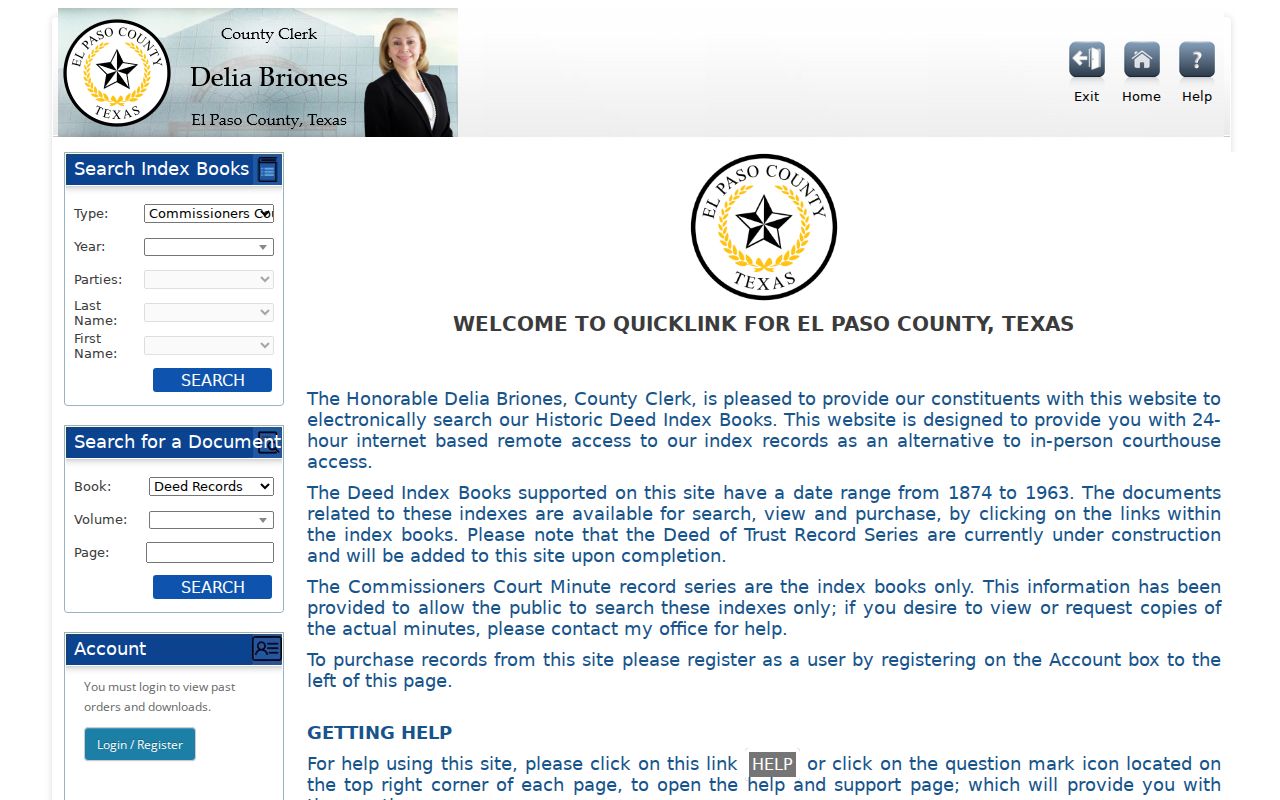
When an image is unavailable, retain the index reference and request the document from the Recording Division rather than drawing a legal conclusion from the search result alone.
El Paso Previous Residents Deed Steps
Property transfers can supply an ownership trail, but they do not automatically establish who occupied an address. Begin with the El Paso Central Appraisal District account or GeoID as a tax-year lead, then compare it with recorded instruments. EPCAD accepts an owner name, address, Property ID, Geographic ID, subdivision, condo, DBA, tax year, type, result size, sorting, and order. It recognizes address searches as StreetNumber StreetName or StreetName. Its current-year information is marked work in progress, and it does not certify situs addresses.
- Save the current appraisal account, GeoID, tax year, and legal-description clues from EPCAD property search.
- Search the apparent buyer or current record party in the historic index or current records portal, then note the instrument’s file date and style.
- Use the seller’s earlier acquisition as the next backward lead, checking whether the party appears as a grantee in the prior transaction.
- Repeat one document at a time, preserving corrections, releases, assignments, or other entries that may change the meaning of a prior record.
- When the online trail stops, use the Recording Division, library or archive resources, and a copy-request route rather than assuming the property history ends.
- Grantor
- The party transferring an interest in an instrument. The role must be read from that record, not inferred from a name alone.
- Grantee
- The party receiving an interest in an instrument. A grantee entry is a dated record lead, not proof of present ownership or residence.
- Chain of title
- A sequence of property-interest instruments traced backward or forward through dated records.
- Legal description
- The lot, block, unit, tract, subdivision, or other formal land description used to connect records when street labels vary.
El Paso Previous Residents Index Limits
Current Official Public Records is the companion portal when a record falls outside the historic-index window or needs a current document search. It accepts Document Number, Deed Name, Subdivision, Style, Book Number, Page, Lot, Block, Unit, Tract, and a From and To file-date range. The style list includes deeds, deeds of trust, easements, liens, releases, plats and maps, restrictions, surveys, powers of attorney, probate-related instruments, wills, and correction or assignment forms.
That portal limits a search to ten documents before a new submission. Narrow a broad result by file date, style, subdivision, party role, or book and page, then document how the result was narrowed. It also warns that the index is not a professional title or lien search. An index reference, an appraisal row, parcel geometry, and a directory listing each carry different weight, so label each one by source type and date.
El Paso Past Residents in Directories
Directories help distinguish a historical listing from a property instrument. UTEP’s digitized collection is free and itemized, with observed El Paso runs from 1885 through 1906. The volumes include publishers such as Rackliff & Wainey, C.A. Gould, El Paso Directory Co., Frank J. McDevitt, Evans & Worley, Worley, and Buck’s. One item description promises an alphabetical directory of citizens and firms, a classified section, and a complete street guide. Exact page fields are not necessarily machine-searchable, so record the volume, page, publisher, and the address as printed.
The El Paso County Historical Society extends the directory run through 2011 and holds photographs, maps, annuals, and family or business records. Its Jane Burges Perrenot Research Library is at 603 W Yandell and is described as free, open three days a week or by appointment; current schedule details should be confirmed. Border Heritage at the public library adds newspapers, vertical files, maps, census material, cemetery sources, and remote or in-person assistance. The fuller collection history belongs with the El Paso city directories; here, each year becomes one dated stop in an address trail.
- Find the earliest directory year likely to include the address and transcribe the entry exactly.
- Check the next available year, retaining changes in street spelling, number, surname, or business notation.
- Pair a directory year with the nearest accessible census, newspaper, obituary, or cemetery source for independent context.
- Use a missing listing as a research gap, not proof that no one was associated with the address.
El Paso Previous Residents and Sanborn
The 1952 El Paso Sanborn map at the Library of Congress has 60 sheets. It can add a built-environment snapshot: lot layout, structure, use, and street geometry. The gallery record does not establish what stood at every address. Check the relevant sheet, note its edition and page, and keep that map evidence separate from a directory’s printed household listing or a deed-index instrument.
The City subdivision viewer is a useful current map layer when a deed uses a subdivision name or lot, block, and unit wording. The county’s subdivision regulations explain that street extensions retain existing names and that address numbering follows city standards, with general even and odd conventions. A plat or deed image controls when a map and index conflict. Address assignment does not by itself establish road or subdivision acceptance.
The El Paso subdivision viewer below provides the A-Z filter and mapped subdivision context used to translate a historic legal-description lead.
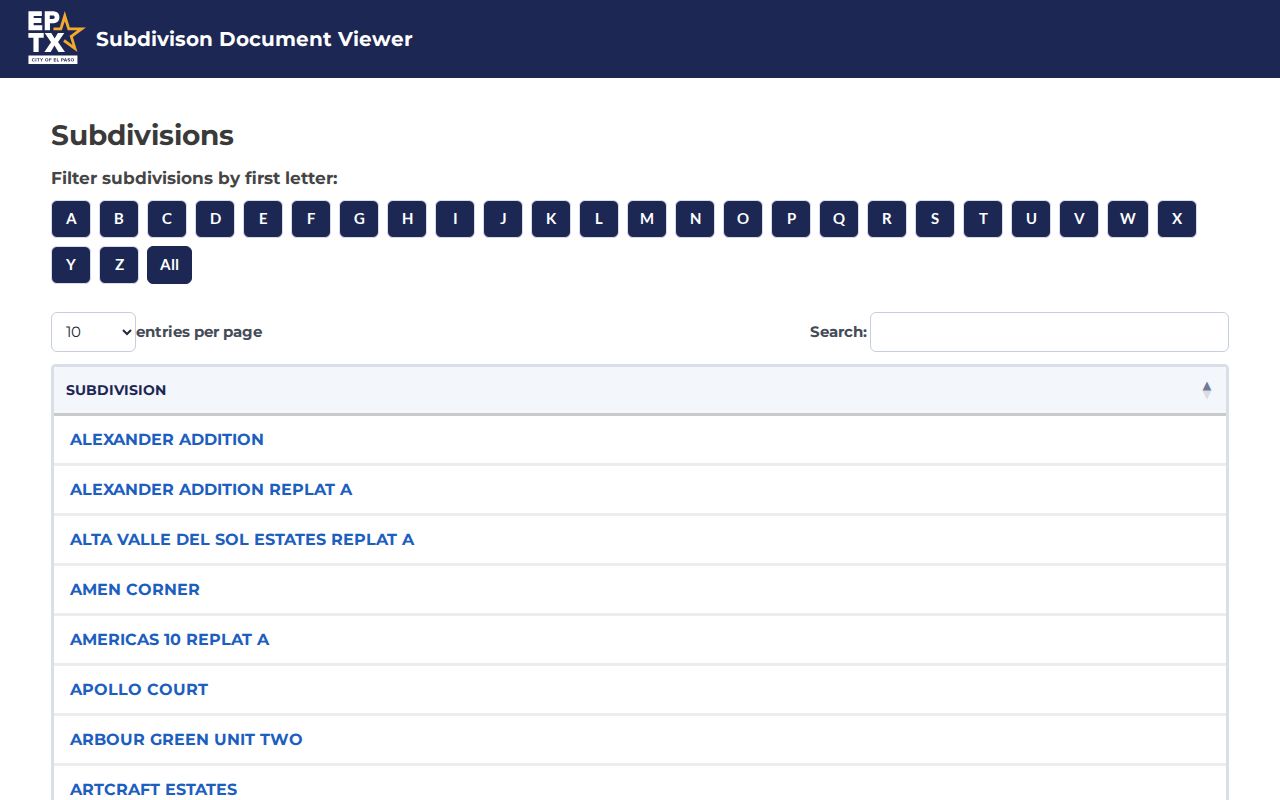
Use the subdivision spelling as a search clue for the deed index and parcel layers, then retain the original instrument wording when the sources do not match perfectly.
El Paso Previous Residents Evidence
A useful El Paso house-history note identifies what each source can and cannot show. A directory can say a name was listed at an address in a particular volume. A Sanborn sheet can describe the structure on its published date. A deed index can point to a recorded instrument. An EPCAD account can provide tax-year appraisal context. City parcel GIS can show geometry. None alone proves a full household history, current residence, legal ownership, or identity.
| Directory line | Historical printed listing; preserve volume, page, year, and spelling. |
|---|---|
| Sanborn sheet | Built context on an inspected map sheet, not a complete occupant record. |
| Deed-index hit | Instrument lead with party role and book or page reference, not a certified title conclusion. |
| Appraisal account | Tax-year account context; EPCAD does not verify situs addresses. |
| Parcel or subdivision map | Geographic or legal-description context, with its own layer date. |
For missing online material, try the City centerline, parcel, and subdivision services; County Clerk Kofile and OPR; Accela permit search for structure context; library, UTEP, Historical Society, or Sanborn archives; and an in-person, phone, email, mail, purchase, copy, or PIA route where the custodian offers it. Property Fraud Alert is a free County Clerk voice, text, or email notice service for filings associated with chosen information. It monitors records; it does not establish residence, ownership, or fraud.
El Paso Previous Residents Historic Names
El Paso County’s history makes date discipline especially important. The county was established in 1850, San Elizario was its first county seat, and El Paso became county seat in 1883. Older sources can use a county, seat, settlement, or street name that does not match a modern map. The county’s history also notes overlapping use of Franklin and El Paso into the 1880s. Preserve the older wording, then use county history, archives, and maps to explain the relationship.
Keep historical research personal and lawful. A past-residents trail is suited to family history, estate or heir questions, local history, and property curiosity. Do not use it to track, threaten, or harass a living person, or to defeat a confidentiality protection. Texas Penal Code §42.072 sets the state’s stalking boundary around repeated conduct that causes fear or substantial emotional distress.
Note: A record not located in an inspected index is an index-only gap, not proof that the address or person had no earlier history.